Tag Archives: Colour Segmentation

24.11.2019 > Human Agency and the Power to Dream

As part of the Sustainable Prospects module of the Master of Arts, I’m collaborating with a group of fellow MA students on a ‘live brief’ for a company that develops unique design, information and wayfinding solutions to integrate people, movement and places.

Our collaboration on the Sustainable Prospects ‘live brief’ culminated in a pitch to our client on 20 November.
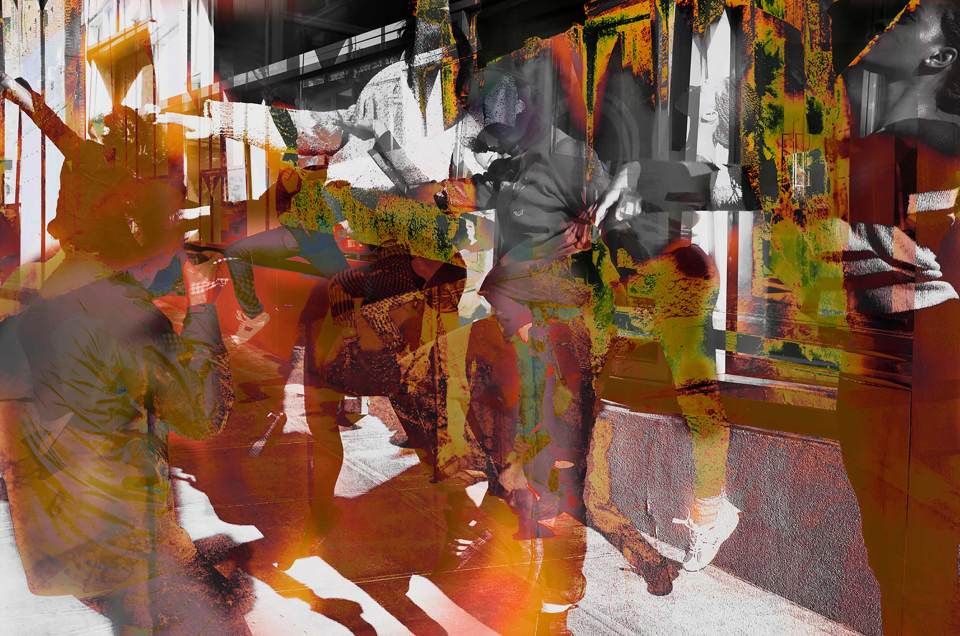
Document-Journal-James-Welling-1538

Fig.1 James Welling, 2016. ‘1538’, from the series Choreographs

My final contribution in the last stages of that collaborative effort was to inform our ideas through research into colour theory (Fig.1) and produce a conceptual image which visually expresses what it means to be human: that is, the capacity to think, decide, act, and to dream.

“Collecting images of work that you admire and keeping them in plain sight (on a pinboard, in a scrapbook, or even on your computer desktop) can be incredibly useful for boosting your own creativity.” [Fordham 2015: 86].

Collaboratively, we’d used this approach not to copy the work of other photographers, but to understand where artists are located in the development path of photographic thought, both technically and critically, or within different schools of photographic thought, so that our own collaborative work could contribute to that development.

How elements of other photographers work are emulated or incorporated into our own work is a valid artistic statement when applied in our own creative manner.

To produce my own visual contribution, I expanded a previous exploration of the concept of social capital by mining my back catalogue (photographic archive).
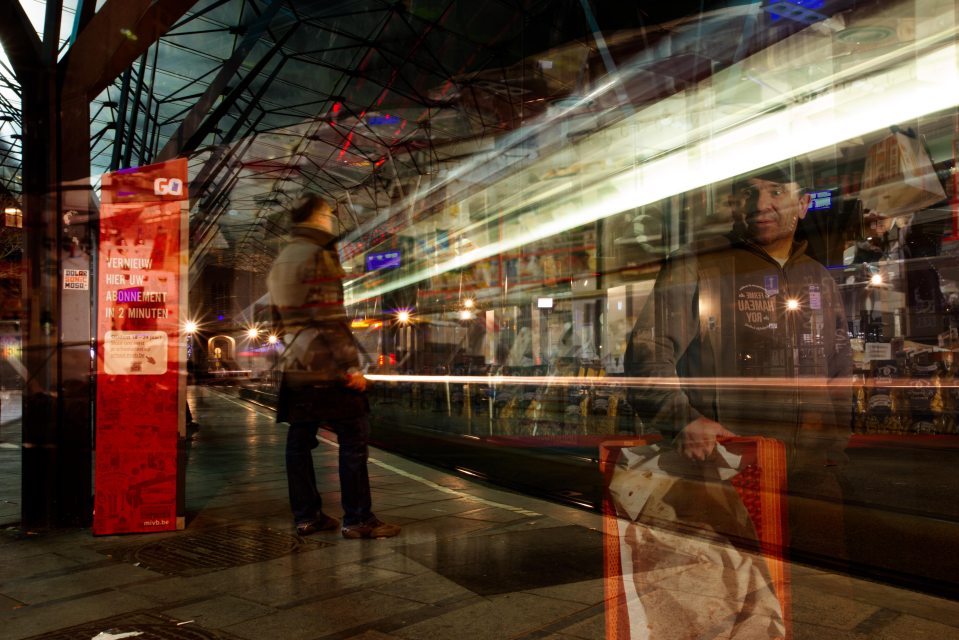
Flagey Market & Transit Station Blend

Fig. 2. Gordon Sutherland, 2019. Unpublished Photographic Sketch, archival blend from the series Market Values (2016)

Using two images from my 2016 series ‘Market Values’, I strove to express that agency in a smart city is not simply about having access to smart technology, but also about the use of that technology to choose and co-create the city that we want to live in (Fig. 2).

Rather than wayfinding, to get from one point to another, as a team we’ve considered these decisions in the context of human questions. What do I need to get done today? How do I want to enjoy myself? How can I be the co-creator off the city I live in? And when I want to get away from it all for a while, what do I dream of, and how do I get there before returning home again?

To anchor the visual storytelling in the future we’ve chosen to steer away from the trend of micro-storytelling around portraiture of individuals in their urban environment today. We suggest to move beyond that trend of ‘everydayness’ into an unknown space: the urban space that people dream of.

To do this we avoid introducing the viewer to individuals; preferring to allow the viewer to enter the image. They can imagine agency they posses in a place where they interact with others and also meet themselves.


Sources

Egeland, V. (2018) James Welling on his photo ‘1538’. Available at https://www.documentjournal.com/2018/06/james-welling-on-his-photo-1538/ [Accessed 10 November 2019]

Fordham, D. (2015) What they didn’t teach you in photo school: what you actually need to know to succeed in the industry. London: Octopus Publishing. ISBN 978-1-78157269-6

04.11.19 > Collaboration Works

As part of the Sustainable Prospects module of the Master of Arts, I’m collaborating with a group of fellow MA students on a ‘live brief’ for a company that develops unique design, information and wayfinding solutions to integrate people, movement and places.

buzz scan street 1

Fig.1 Christoper ‘Buzz’ Mathews, 2019. Test image for Sustainable Prospects ‘Live Brief’ Collaboration

During this module I’ve focused on practicing sustainable photographic collaboration through the ‘live brief’ project. In previous modules I’ve worked closely with my tutors and participated in the weekly webinars with fellow students. For this module, I’ve opted to participate in weekly meetings with the collaborative team working on the live brief.

Since our first meeting in early October this teamwork has been, in reality, a kind of weekly group tutorial. A genuine team spirit emerged (as we formed, stormed, normed, and performed) and we managed to keep each other going through the tough times. There was always one of us on the up, which kept the team motivated.

This type of collaboration is what photographic collaborative practice is really about, and why my personal approach to long-term collaborative business relationships prefers the use of LinkedIn as one of my digital communication channels. Together with my portfolio website and twitter account, these social media channels embody my principle of long-term partnerships and exchange on professional photography and the socio-political issues which drive me to create photographic images.

“The photo industry runs on word of mouth, so you must strive constantly to develop an excellent reputation” [Fordham 2015: 32]

It’s therefore necessary to treat every job as the pitching opportunity to get the next one, and every collaboration as a professional one.

Here I present my contribution to the team effort which culminated in a presentation of our preliminary thoughts about the ‘live brief’ to our module leader and course coordinator on 1st November.

We’d been discussing colour segregation as a means of visualizing agency in the cityscape.

But how does such an image and collaborative effort across time zones evolve? It evolves both structurally and organically.

During our discussions Amy had suggested using 35mm run through a medium format camera as a technique and Buzz had scouted locations and registered a number of test images (Fig. 1).

I then used one of the images taken by Buzz to explore the application of colour theory in the development of the digitalized images. The concept of colour segmentation was intended to express individualism, agency and inclusivity in modern society through the use of the seven colours of the rainbow.

buzz scan street 1-Edit-Edit-1

Fig.2 Christoper ‘Buzz’ Mathews and Gordon Sutherland, 2019. Test Application of Colour Segmentation for the Sustainable Prospects ‘Live Brief’ Collaboration #1

As an alternative creative approach – again picking up on an idea suggested by Amy that we could emulate line drawings – I developed an offset image, with a view to accentuating the outline of the individuals and an architect’s sketch like rendering of the urban landscape [Fig. 3].

buzz scan street 1-Edit-Edit-2

Fig.3 Christoper ‘Buzz’ Mathews and Gordon Sutherland, 2019. Test Application of Colour Segmentation for the Sustainable Prospects ‘Live Brief’ Collaboration #2

The concept would not make the final cut of our pitch to the client, as other ideas were emerging, and overall we agreed that the images with the film sprockets would become repetitive: elements of the client brief were emerging and the images would be used to accompany a series of essays on agency in a smart city future, and we agreed that while interesting, we needed to follow another approach.

Since the book would act both as a reference document for the client’s business sector, as well as providing visibility, helping to establish our client’s position at the forefront of wayfinding in the urban environment we wanted to explore further the concept of agency in the SMART city.

That meant we would need to communicate the essence of what it means to be human: that is, the capacity to think, decide, act, and to dream.


Sources

Fordham, D. (2015) What they didn’t teach you in photo school: what you actually need to know to succeed in the industry. London: Octopus Publishing. ISBN 978-1-78157269-6