
In looking for a way forward for my art photography I need to step outside of my comfort zone, deconstruct myself, and understand – and explain – how I arrive at my visual artistic expression. That means dissecting and explaining the process through which I start from a theme, a concept, an exploration of subject matter, techniques and perspectives, as well as an exposing of my response to life, so as to arrive at the final emergent artwork: aka my artistic strategy.
The artwork will come into its photographic self on a support – a surface – whether that be the printed image hanging in a gallery, in a photobook, on advertising billboards, as a presentation during an artist talk or workshop, shown as a poster, as a projection, on digital screens, or as holograms: aka my chosen – or preferred – artistic surface.
The current concept for my Final Research Project – The Digital Divide – is to explore human life in a digitally controlled environment, in a ‘Smart City’ for want of a better terminology, through the use of spatial representation:
The Digital Divide (Working Title) is a visual investigation of ideas, concepts, and critical theory surrounding the nature of digital space and human interaction with it. The project starts by exploring the portals in society through which we enter the datasphere and leads to documentation, representation, and probing of life in a smart city.
Ultimately the project questions the space for human existence in the smart city.
Smart cities are characterized by data collection, analysis and responsiveness of the rhythm of city life to the data flows. The question arises, at which stage does the city respond to societal needs and at which stage does it start to shape those needs? (Sutherland 2018).
In a physical sense, this spatial representation may be the urban landscape, the infrastructure of the city, or its human inhabitants and how they interact with the digital world. In a meta-physical sense, the exploration is based on representation of the datasphere, or cyberspace, as existential space.
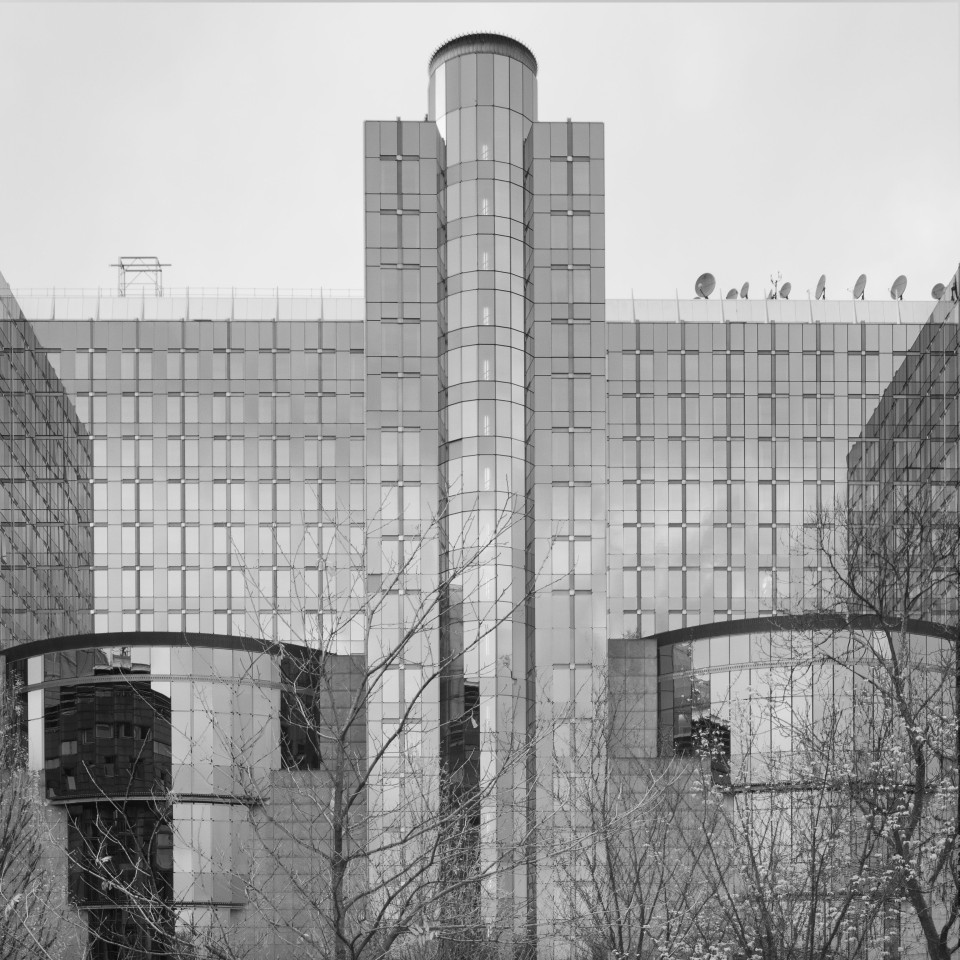
Fig. 1 Altiero Spinelli Building from Parc Leoplold, European Parliament Complex, Brussels © 2018 Gordon Sutherland
So far, my approach to arriving at a fully developed concept for the Final Research Project has been to explore the various elements of spatial representation, whether physical or digital, through mini-projects. These are a group of individually hermetic projects, artistic explorations, each responding to different elements of the two domains, the tangible physical space and the digital space, mainly – thus far – at the junctures where they meet. These junctures I call ‘portals’, and inter-alia they include mobile devices, computers, telecommunications masts, antennas, parabolic dishes, LED screens (where information is projected from the datasphere towards the inhabitants of the physical domain) and surveillance cameras (where the movements of inhabitants are collected and transferred to the digital domain for processing).
My mini-project This Time I’m Voting (Fig. 1) constituted a photographic enquiry of the interplay between architecture, surveillance and technology in the public space of the European Parliament Complex in Brussels, Belgium, created as work in progress whilst exploring my position vis-à-vis the photographic medium and this individual photographer’s collaborative practice with his camera, during the run up to the European elections [Photography MA Module: Positions & Practice PHO701].
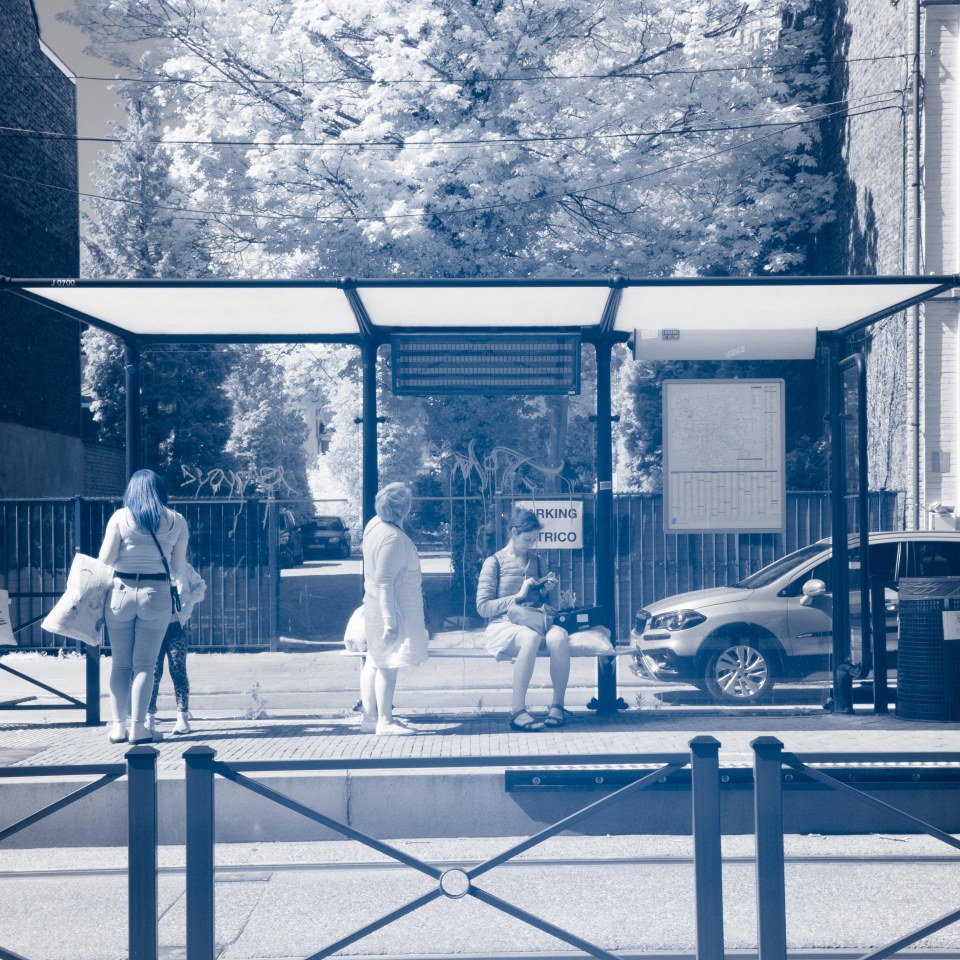
Image: Miroir Transit Station, Jette, Brussels © 2019 Gordon Sutherland
In the series The Broken Places (Fig. 2), through pseudo psycho-geography (that is, digitally nudged psycho-geography), information from digital apps and LED screens was used to direct the photographer and his camera around the nineteen city burghs of the Brussels-Capital Region. The resulting images explored the continuous nature of digital space, or the cloud, juxtaposing these against the administrative boundaries of each of the burghs. In parallel it explored the cityscape as a visual representation – or surface – of the underlying hegemony in a late-capitalist democracy [Photography MA Module: Informing Contexts PHO702].
Using this approach, and wondering how I would respond – and visually represent – a highly advanced digital society, I scheduled a trip to Tokyo in July 2019 for the next step of my work in progress to inform the ideas that would underpin my Final Research Project. [MA Photography Module: Surfaces & Strategies PHO703].
In parallel, given that the Falmouth MA Photography Face-2-Face scheduled at Les Rencontres de la Photographie ARLES 2019 would take place during the period when I was in Tokyo collecting the photographic material for my work in progress, I opted to visit the International Photography & Visual Arts Festival PHotoESPAÑA 2019 in mid-June, having researched the Programme of events [PHotoESPAÑA 2019].
My response to, and interpretation of these exhibitions, as my own human surface came into contact with the photographic surfaces, is documented in a series of posts. The exhibitions were selected based on the concept of transformation: that is, cities and people in transformation and the visual lens based representation thereof. Otherwise, entities which are plastic and constantly morphing into another state of being, just as society is currently being shaped by, and shaping, its ongoing digital transformation. [MA Photography Module: Surfaces & Strategies PHO703].
Fig. 3 Surfaces & Strategies Workbook, June – August 2019
As with my proposal for the Final Research Project, in which I suggest to explore the digital domain using only analogue techniques – almost as a voice of defiance – I have continued to document my work in a tactile, handwritten workbook containing the thoughts and sketches around my theme, approach, strategy, and outcome from which excerpts and photographed images are transcribed to this online journal. Finally, it seems, there is no escaping the digital realm.
The following posts are the result of that transcription, documented in a manner intended to give insight into my strategy for expanding my photographic practice and spheres of influence. An image of the photographer emerges through a kind of join-the-dots process, eventually revealing the photographer, as well as the images as they become their photographic self.
References
PHotoESPAÑA 2019 (2019) International Photography & Visual Arts Festival PHotoESPAÑA 2019. Available at http://www.phe.es/en/ [Accessed 10 June 2019]
Sutherland, G. (2018) PHO701 Research Project Proposal. Submitted for the MA Photography Module Positions and Practice, Falmouth University, December 2018
 Gordon Sutherland - Photography Research Journal