Tag Archives: Contextual research

29.09.19 > On the search for new dimensions

I continue to take forward my study of spatial representation through photography, in particular the study of digital space. I’m planning to pick up more of the cinematographic, gaming and manga influences I’ve come across through my previous projects, such as ‘The Space Between’. I’m once again thinking of looking into ‘in-game’ photography as a depiction of space in the datasphere.

I plan to revise the proposal for my Final Research Project, and consider expanding my work from its current exploration of data flows in connected urban environments to an exploration, through non-anthropocentric photography, of how systems with intelligent algorithms ‘view’ the real world.

For these two avenues of exploration I’m thinking – at this stage of my research – of connecting with communities in the gaming world on the one hand, and to deepen my research into practical operations of smart city systems on the other.

Currently my final research project – The Digital Divide (Working Title) – is conceived as an exploration of human life in a digitally controlled environment, in a ‘Smart City’, for want of a better terminology, through the use of spatial representation:

The Digital Divide (Working Title) is a visual investigation of ideas, concepts, and critical theory surrounding the nature of digital space and human interaction with it. The project starts by exploring the portals in society through which we enter the datasphere and leads to documentation, representation, and probing of life in a smart city (Sutherland 2018).

In looking for new ‘dimensions’, I’m exploring research-based photography to identify methods that could inform my own approach.

Below two examples of photographers whose research approach can relate to my own project.

Artist and photographer Meret Wandeler focuses her photographic research on the transformations of urban fabric in suburban areas. Long-term photographic observation is a key approach in her practice, as is the collaborative nature of projects (Wandeler 2019a). Her serial projects are characterized by the fact that the research constitutes the final body of work.
Wendeler 2019

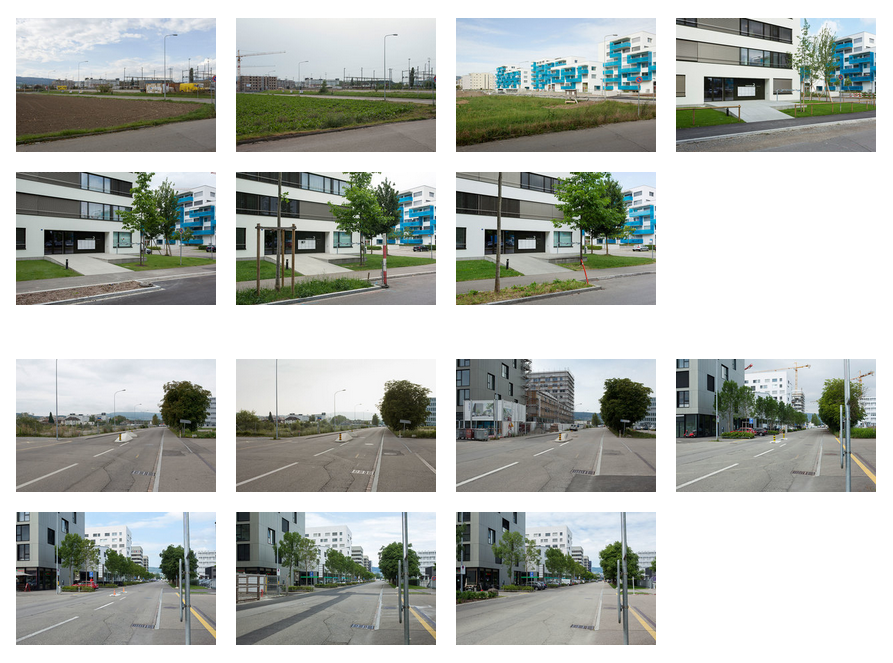
Fig. 1. Meret Wandeler/Ulrich Görlich, 2005, Elmar Mauch (Rephotography) 2007, Christian Schwager (Rephotography) 2009–2017, Example of overviews from ‘Long-Term Photographic Observation of Schlieren 2005-2020’ (Wandeler 2019b)

The ‘Long-Term Photographic Observation of Schlieren 2005-2020’ is an example of visual research into the ongoing processes of transformation in one specific community, located in this case in the Zurich Metropolitan Area.

Through urban transformation, initially evolving from a farming village to an industrial zone in the post-war period, Schlieren ended the 20th Century as a ‘non-place’, as globalization led to the abandonment of its industrial sites (Wandeler 2019b: 366).

Wandeler, in collaboration with Ulrich Görlich, sought to document the impact of a holistic urban redevelopment in the early 21st Century, with the pressure on land use and environmental degradation in Switzerland being high on the political agenda (idem: 368).

The project, centred around the method of rephotography (with the rephotography by Elmar Mauch and Christian Schwager), was the first photographic research project at a Swiss Art Academy in the emerging field of artistic research which became established in Europe at the turn of the millennium, mainly in Scandinavia, the United Kingdom and Switzerland (idem: 370).

Considering work of another artist, Melanie Manchot’s research-driven, lens-based artwork employs photography, video, film and sound. Manchot has stated that “Cameras, whether still or moving, are crucial devices shaping the construction of the work” and more importantly “are an organizing principle, an apparatus that becomes part of a set of relations I wish to create” (Parafin 2016).

Manchot’s methodology is built on the processes of exchange, contribution and collaboration. She often involves social groups, or communities, to create serial portraits at the boundaries of documentary and fine-art. The works constitute a discourse on the individual and social self (idem).

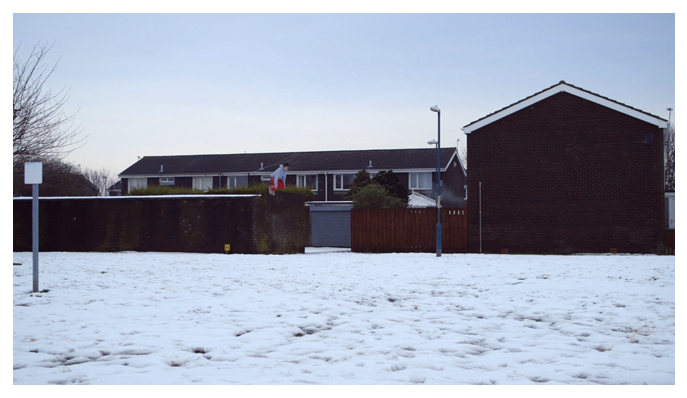
In ‘Tracer’ – a single channel projection and 3 channel installation, 19’45” in stereo sound – Manchot depicted the movements of parkourists as they sought out the opportunities and limits offered by constructed space to produce specific forms of physical interaction. As Manchot explains on her website

“The film draws attention to how human agency may act upon built environments and questions the authority inherent to architectural form” (Manchot 2019).
Manchot Tracer Still 2013

Fig. 2. Melanie Manchot, 2013, Still from Tracer (Manchot n.d.)

Tracer was funded by the Great North Run Moving Image Commission as part of the event’s culture programme and saw Manchot working “with a group of local parkour runners to re-imagine the architecture and spaces along the route” (Great North Run Culture 2013).

Long, slow sequences and overseeing viewpoints in the video serve as a reminder to the viewer of surveillance in public space, as well as our individual and collective role as voyeur on society. Stereo soundscapes offer alternative views into the physicality of parkouring as the impacts of human bodies on constructed space are revealed (Manchot 2013).

Sources

Great North Run Culture (2013) Melanie Manchot: Tracer. Available at http://greatnorthrunculture.org/aboutcommission198a.html?commid=63   [Accessed 29 September 2019]

Manchot, M. (2013) Tracer, 2013 – Trailer. [Video] Available at https://vimeo.com/220456235 [Accessed 29 September 2019]

Manchot, M. (n.d.) Tracer, Video Installation, HD, 19’43”. Available at http://www.melaniemanchot.net/category/tracer/ [Accessed 29 September 2019]

Parafin (2016) Artists – Melanie Manchot. Available at http://www.parafin.co.uk/artists–melanie-manchot.html [Accessed 29 September 2019]

Sutherland, G. (2018) PHO701 Research Project Proposal. Submitted for the MA Photography Module Positions and Practice, Falmouth University, December 2018

Wandeler, M. (2019a) Meret Wandeler. Available at https://www.meretwandeler.net/ [Accessed 29 September 2019]

Wandeler, M. (2019b) Schlieren: Spatial Transformation in a Suburban Municipality in Switzerland. In Framed Landscapes: European Photography Commissions 1984-2019. Exhibition Catalogue, Museo ICO, 6 June to 8 September 2019). Madrid: Fundación ICO.
14.02.19 > Becoming Other

As I work towards a photography project that invites dialogue on the datasphere as an alternative space of existence, I plan to travel to Tokyo to explore the visualization of digital connectivity in one of the most densely constructed and populated megacities on the planet. My starting point is to tentatively explore Japanese culture, art and photography, and how they have been informed both domestically and by external cultures.

Japan and its culture remain an intrigue for Western Society. In the first of a three part series addressing art and aesthetics in Japanese culture (The Art of Japanese Life: Nature, 2017) the embodiment of the religious beliefs of Shintoism and Buddhism within the Japanese aesthetic are explored by art historian, and fellow at Gonville & Caius College Cambridge, Dr. James Fox (University of Cambridge, 2019).

Reflecting on the role of nature within these two religions, Fox considers that every aspect of life in Japan is driven by aesthetics. Even if Shintoism itself has not produced a legacy of art such as that emanating from the Christian religions of the West, the essence of the religion is so firmly embedded in the Japanese aesthetic that it pervades Japanese art.

The world of Shintoism is inhabited by the Kami, spirits – both good and bad – that live in everything organic and inorganic, or as Fox states, “for Shinto, the world is endlessly animated by the divine” (The Art of Japanese Life: Nature, 2017).

This concept of eternal existence is extended in Buddhism by the belief in incarnation whether as the living or inanimate, and parallels with these ancient religions can be found in contemporary philosophical studies, such as in Felix Guattari’s unfinished concept of ecosophy which would allow for a rethinking of the nature of being. A dissolution of self by becoming-other is at the heart of Guattarian (and Deleuzian) ecosophy, in opposition to an expansion of self through identification (Tinnel 2012: 359).

Just as the Japanese accept that life pervades everything, in whatever form, it is at today’s juncture of the ecological crisis and the pervasiveness of digital media associated with the information age, that a Guattarian thinking could point towards alternative domains or “transversal eco-humanities, which would be rhizomatically rooted in autopoiesis and becoming-other” (idem: 357), but “without assigning humans, nature or culture a fixed role or place in the production of subjectivity” (idem: 362). In questioning this, is Tinnel’s extension of the unfinished theory of ecosophy suggesting the possibility of existence in other form? Digital form? And how could such alternative digital spaces be visualized when we look at them through the filter of the human condition? Further, if we enter a digital space which exists only in the information age, do we become less human?

This bridge between religion and philosophy within the context of ecosophical – as opposed to ecocritical – thinking is at the heart of my visual exploration of otherness. The dominant physical infrastructure and prevalent, but juxtaposing, digital connectivity in Japan offer an avenue for photographic exploration of otherness outside of the Western media filter.

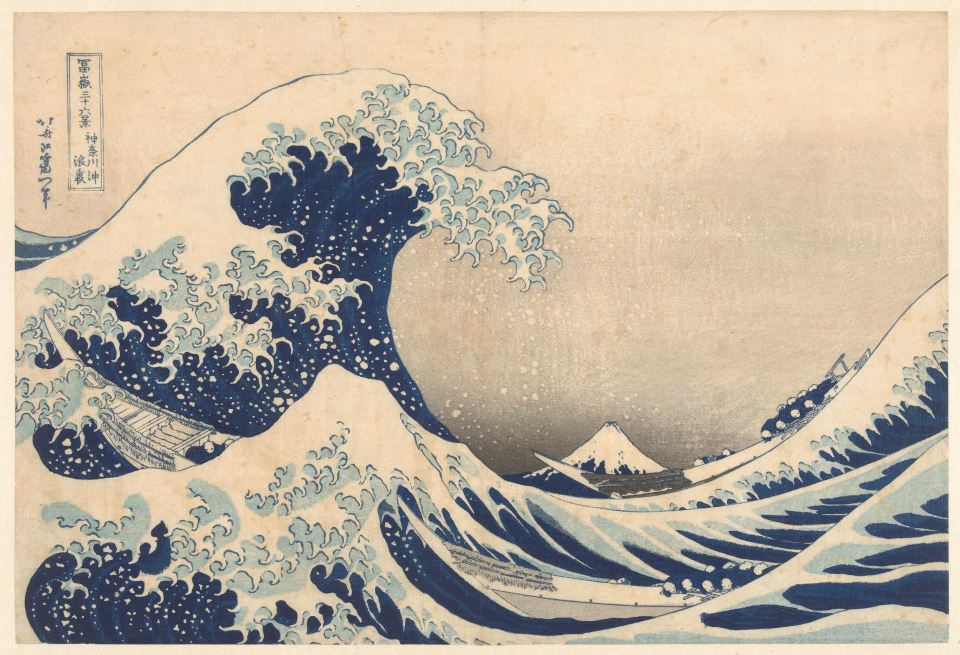
Returning then to the Japanese aesthetic, an exploration of the universal divine animation in Japanese photography would have to take as its starting point the development of the Japanese aesthetic, in particular the Japanese culture of visualization. With ‘The Splashed Ink Landscape’ (1495), Sesshū Tōyō expressed an abstraction of nature some 300-400 years before the advent of abstraction of landscape art in the west, whilst consideration of the Japanese reading of art from right to left will reveal to the uninitiated western eye insights into the semiotics of the imagery. In reading Hokusai’s The Great Wave off Kanugawa from right to left (Fig. 1, also know as Under the Wave off Kanagawa, Rijksmuseum n.d.), the western interpretation of the immensity of nature’s energy is revealed in Japanese culture as the immensity of life’s challenges (The Art of Japanese Life: Nature, 2017).

Hokusai Great Wave

Fig. 1 Katsushika Hokusai, 1829-1833. Under the Wave off Kanagawa [25.4 cm x 37.5 cm, colour woodcut print on paper] (Rijksmuseum, Acquisition 1956)

This reverence for the immensity of nature in the Japanese aesthetic is balanced by a cultural fascination for the fleeting. The cherry blossom, Prunus Cerelatta, is an example of this. The national, and now global, celebration of this delicately petalled tree flower disguises the cultural melancholy that the most beautiful things dazzle for such a short time, the human condition amongst them. As Fox states, the cherry blossom is to the Japanese “a reminder that our lives also are painfully brief” (idem). The brevity of the cherry blossom offers an interesting parallel to the potential brevity of a life in the datasphere.

It is the duality of this Japanese fascination with the fleeting, combined with a cultural drive to control nature, the outcome of which is no better represented than in the Fukushima disaster, that makes consideration of otherness through a Japanese perspective central to my work on visualizing other forms of existence in the information age.

In his consideration of the art of Japanese life Fox reflects that “in Japan nature is ignored at one’s peril” (The Art of Japanese Life: Nature, 2017). That we should ignore our own ‘nature’ through dissolution of the human condition to a digital existence is surely perilous and worthy of dialogue, visual dialogue included.

Sources

Rijksmuseum (n.d.) Under the Wave off Kanagawa. [Online]: http://hdl.handle.net/10934/RM0001.COLLECT.45735. Available at https://www.rijksmuseum.nl/en/collection/RP-P-1956-733 [Accessed 9 February 2019]

The Art of Japanese Life: Nature (2017) BBC World, 19 January 2019. 10:10 CET. Part 1 of a series produced and directed by Ben Harding. BBC Studios, Pacific Quay Productions, Scotland.

Tinnell, J. C. (2012), Transversalising the Ecological Turn: Four Components of Félix Guattari’s Ecosophical Perspective, Edinburgh University Press, Deleuze Studies, 6.3 (2012): 357-388

University of Cambridge (2019) People: Dr James Fox MA (Cantab), MPhil, PhD. [Online] Available at https://www.hoart.cam.ac.uk/people/jf283@cam.ac.uk [Accessed 31 January 2019]


12.11.18 > The Digital Divide (Working Title)

The ideas, concepts, and critical theory underpinning my initial considerations for a project investigating the nature of digital space are collated in the video The Digital Divide, an Artist Talk presenting the road to my visual voice and early research for the project.

23.10.18 > Surveillant or surveyed? – Photography, the double agent

The idea of the datasphere as existential space is the main avenue of current exploration for my Final Degree Project.

The datasphere is considered as the “notional environment in which digital data is stored” as well as “the space of virtual reality, or cyberspace” (Oxford Dictionaries 2018).

My thematic direction for this project remains open, my initial considerations lying in identifying how a space as invisible as the datasphere can be visualized.

Where do people, individually or collectively, enter into, or interact with, the datasphere? Can those portals be associated with visual markers? How much of the human condition is lost through interaction with, and habitation within, a digitalized world?

image001

Fig. 1: Sunday, October 7th 2018 in Place Eugene Flagey, Brussels, Belgium (Image © Gordon Sutherland 2018)

Musings on surveillance, propaganda and societal control by the gatekeepers to the datasphere and considerations around policing of cyberspace point to potential literary and visual texts as inspiration: Orwell’s Nineteen Eight Four, the Wachowskis’ The Matrix, and Toffler’s Future Shock, for example. How much information can a society absorb before it suffers from culture shock within its own culture?

But where is this digital world and is it tangible enough to be visualised? How is it changing society?

A recent Pew Research study in the United States shows that teens are trying to find the balance between the anxiety of spending too much time on their mobile phone against the worry they feel when they are separated from it (Tiku 2018). Whilst the youngsters involved reveal that they are taking steps to limit the time they spend on their phones, these efforts aren’t necessarily making them happier. Over fifty-five percent of American teens have feelings of anxiety and loneliness – or felt upset – when they are away from their mobile phone.

The report states that American parents also struggle with similar issues in relation to screen time, sometimes to a greater extent. Thirty-nine percent of parents admit to often or sometimes losing focus at work when looking at their mobile phone, this in comparison to the thirty-one percent of teens who state to having lost focus during class time for the same reason. Further, fifty-one percent of teens say that whilst trying to have a conversation with their parent or caregiver, the other person has been distracted by mobile use.

The layers of digital invasiveness in day-to-day life are not only from mobile phones, but come in the form of notifications through various media. These notifications shape the way we live and respond to those around us. I find myself wondering what would happen if the notifications stopped? How would a contemporary digital society respond without these signals?

The 2014/15 exhibition “Watching You, Watching Me” at the Open Society office in New York featured the work of nine visual artists documenting and exploring the surveillance and data retention activities of governments, corporations, and individuals. The exhibition explored not only how photography has been used as much to challenge the practices of surveillance as it has itself been an instrument of surveillance.

Of interest for further research is the work of Edu Bayer for the New York Times in 2011 in which he documented the surveillance apparatus of Colonel Muammar al-Qaddafi’s regime, the headquarters of which were housed in a six-story building from which citizen’s movements and correspondence was monitored (Bayer n.d.). The work can be viewed in the context of ‘the ruin’, exposing surveillance in its aftermath.

In his work ‘Plain Sight: The Visual Vernacular of NYPD Surveillance’, aka profiling.is, Josh Begley uses Associated Press released visual texts to produce a wall of images from the NYPD’s surveillance of institutions of businesses affiliated to the Muslim faith. In this project the data artist, filmmaker, and app developer Begley draws attention to the scale of photography’s role in state apparatus surveillance activities. The wall of surveillance material makes me think of a massive contact sheet. Taken more subtly, reference can be found in the display approach of Bernd and Hilla Becher.

Over two years, Simon Menner had access to the Stasi’s visual legacy archived by the Federal Commissioner for the Stasi Archives of the former German Democratic Republic. Menner’s presentation of the images allows reflection on the use of photography as a tool at the service of the secret police, whether for training secret service agents, conduction of clandestine home searches, or to track people’s movements (Yamagata 2014). Menner states “They concern photographic records of the repression exerted by the state to subdue its own citizens. For me, the banality of some of these pictures makes them even more repulsive.” (Menner 2018). He further reflects that many of the images are fully open to interpretation making them susceptible to attribution of meaning according to the suspicions of the secret service.

Perhaps the discourse around surveillance, truth, and the (mis)use of data is not too distant from the broader photographic debates of subjectivity and objectivity, or discussions on the fundamentals of intertextuality between visual and written texts. What is the true reading of a photograph in the absence of corroborated written or recorded texts?

The idea of photography as a double agent, or perhaps simply the devil’s advocate, arises in the discourse around its capacity to awaken social conscience of the role that surveillance and state control play with regards to fundamental rights and civil liberties. The ubiquitous nature of the ‘connected’ camera phone and tethered or wi-fi enabled DSLRs means that in both citizen documentary and professional photojournalism, photographers are as much capturing images of socio-political concern with a view to informing the viewing public, as they are providing evidence for use by the surveillance apparatus of the state and other organisations, real or virtual.

The philosophical question remains: is virtual also real? And what does photography the double agent have to say in this debate?

Endnote

Whilst reflecting on surveillance in the data age I was listening to the soundtrack from the film Good Bye Lenin!. The music recalled the story of the fabricated reality created by a young man to protect his mother from shock after she awakes in 1990 from a long coma, to prevent her from learning that the nation of East Germany that she knew and loved had disappeared, and together with it much of her identity [Yann Tiersen 2003].

Sources

Bayer, E. (2018) Gadhaffi Intelligence Room. Available at https://edubayer.photoshelter.com/index/G0000nniWlU_S9oM [Accessed 22 October 2018]

Begley, J. (n.d.) The visual vernacular of NYPD surveillance. Available at https://joshbegley.com/ [Accessed 22 October 2018]

Menner, S. (2018) Images from the Secret Stasi Archives
or: what does Big Brother see, while he is watching?
Available at https://simonmenner.com/_sites/SurveillanceComplex/StasiImages/_StasiImagesMenue.html [Accessed 22 October 2018]

Oxford Dictionaries (2018) Definition of datasphere in English. Available at https://en.oxforddictionaries.com/definition/datasphere [Accessed 21 October 2018]

Tiku, N. (2018) Even teens worry that teens are addicted to their phones. Available at https://www.wired.com/story/even-teens-worry-that-teens-are-addicted-to-their-phones/ [Accessed 21 October 2018]

Yamagata, Y. (2014) Taking a closer look at surveillance culture through photography. Available at https://www.opensocietyfoundations.org/voices/taking-closer-look-surveillance-culture-through-photography [Accessed 22 October 2018]

Musical inspiration

YANN TIERSEN, 2003. Good Bye Lenin! [CD]. 7243 5 82548 2 2. Labels

20.10.18 > The global image

Fig. 1: Students participate in a photography summer school at Central St. Martins – University of Arts London (August 2018)

The global image is all around us: ubiquitous and pervasive. We are bombarded by images. Try walking down the street consciously ignoring every image that you see. Make an effort to delete them from your field of vision. The world quickly becomes uncluttered. It seems that the still image is everywhere, pushed aside only by the multitude of moving images that steal our attention, pulling us in through a kind of animal instinct that focuses on movement.

To continue to gain our attention the global image stretches the boundaries of cultural acceptance before becoming banal or mundane. An alien browsing photographic archives of personal photographies in the second decade of the 21st Century on planet Earth might be excused for thinking that we are a profoundly communal species sharing moments by peering out of digital slices of time, whether to express, to consume, or perhaps to be consumed. Like fledglings in a nest consciously, or unconsciously, needing to attract attention to survive in a competitive world.

The boundaries of photographic representation once determined, they become the quotidien acceptance of the global image as an unconscious representation of society today. And so the next step in pushing the boundary of photographic representation must arrive and photographies evolve further: continuously flexible temporal networks, or interconnected systems, which interlink visual representations of space, time, reality, imagination and the human condition.

When everything has been photographed what is there left for photographers to do? I remember wanting to visit an exhibition at the Pompidou Centre a few years back, which explored the concept of there being nothing left to photograph. The queue was too long, so I’ve been left with my own thoughts on the possibilities that remain for photography now. Are they endless?

The pervasive nature of photography is not a new phenomenon. Hand (2012) informs us that “the New York Times ran a story in 1884 concerning an ‘epidemic’ of cameras, with amateurs described as ‘camera lunatics’ training their cameras simply on those walking down the street” (Hand: 4). The sociological response to this was similar to today’s concerns about privacy, invasiveness, decency and the breakdown of societal norms.

In the image above a photographer takes an image of photographers talking about photography: this allows for humorous or iconic discourse, revealing aspects of today’s version of this lunacy (Fig. 1: Sutherland 2018).

In another instant, the photographer ‘steals’ a moment of someone sleeping, a private moment in which the person is disconnected from self-consciousness, captured consciously by a photographer using an optical instrument which records unconsciously (Fig. 2: G. Sutherland 2018).

Fig. 2: Sleeping visitor in the National Theatre, Southbank, London represented in IR 590nm post-processed to black & white (August 2018)

Reflecting on my place within the concept of the global image, I again recall lyrics from Coastguard by British Sea Power: “We’re all in it, we’re all in it, we’re all in it and we close our eyes” (British Sea Power 2013).

It seems inherent to photographies as visual expressions of personal or cultural world-views that they concern the boundaries of the socially acceptable. Photographic images have the ability to grab attention, when the written or spoken word can’t be heard above the voices of others. It could be that what is stated visually, has more potency than written language, albeit with less clarity. Perhaps this is because of its ambiguity?

In photographic practice I’m increasingly challenged to remake any image brought into the photographic realm, or saturated as Walter Benjamin would have stated it, from amongst all the concepts of images in the minds of a world of photographers. That said, it can make sense to look at new light through old windows, or to project new considerations of old stories in the light of the (digital) age in which we now live. Times have changed and so have the interpretations.

Fig. 3: Art gallery visitors in the Tate Modern Turbine Hall represented in IR 590nm (August 2018)

The question remains: is there anything new under the sun to photograph? And will it remain ‘new’ once it has come into existence from its previous existence as an idea ready to become a photograph?

For the most part, commercial and art photography today sit both within and aside of the realm of digital photography, which in itself is a sub-culture of digital culture. They sit within it when they conform to its norms, they sit apart when they are breaking those norms. Yet, once they break the norms, they become part of the norm. “The Shape of Light” abstract photography exhibition at the Tate Modern in 2018 was an example of a critically acclaimed and publicly accessible photography exhibition which demonstrated how photography has taken its place with other arts, on a mass scale, as art for awakening conscience and art for consumption (Fig.3: G. Sutherland 2018).

The other part of this sub-culture is personal photography and together they reveal everyday photographic practices, whether production or consumption, which in “contemporary Western cultures involve unprecedented levels of visual mediation” (Hand: 3). Even analogue or alternative photographies rely on digital distribution and consumption, clearly placing photography as a part of today’s digital society.

For my part I interpret the concept of the global image ontologically as the current culture of production and distribution of images through which they pervade every aspect of our life, whether as personal or professional photographies. Photographic image has become an intrinsic part of our existence.

Sources

BRITISH SEA POWER, 2013. Coastguard. In: From the sea to the land beyond [Vinyl]. RTTRDLP679. Rough Trade Records.

Hand, M. (2012) Ubiquitous Photography. Cambridge: Polity Press. ISBN-978-0-7456-4715-9


18.10.18 > We’re all in it

herbert list

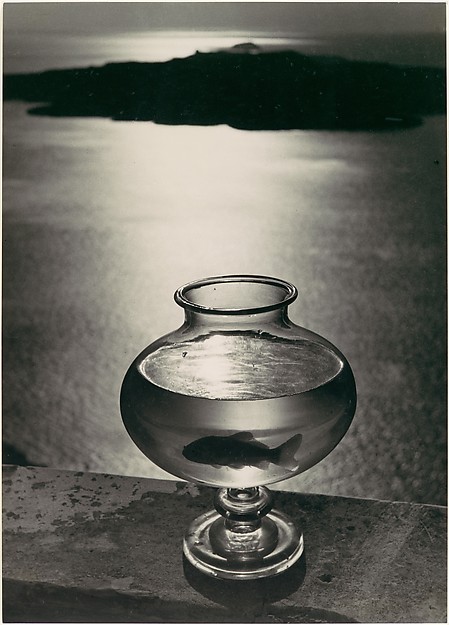
Fig. 1 Herbert List, 1937. Santorin 1937. [36.3 x 26.0 cm (14 5/16 x 10 1/4 in.), Gelatin Silver Print]

We’re all in it, We’re all in it and we, We’re all in it and we close our eyes

It enfolds, The salt, the spray, the gorgeous undertow, Always, always, always the sea, Brilliantine mortality

Close our eyes, Close our eyes, We’re all in it and we close our eyes


from

Coastguard (British Sea Power 2013)


By 1936 Herbert List had been forced to leave Germany due to the political situation (Bieger-Thielemann 2001: 396) and in the greater cultural context of 1937 fascism was taking its hold across much of the European continent. The cultural context of the time constitutes the backdrop for exploration of List’s image on many levels, whether in terms of the European continent in the greater world, in terms of impending unsettled times, or in personal terms for the photographer.

Two worlds are revealed, the goldfish bowl and the sea, otherwise the microcosm and the macrocosm. The apparent freedom experienced by the viewer contrasts with restricted environment of the fish, the large fish in the small bowl commands its small world, the still waters in the bowl are a counterpoint to the choppy seas.

From a formal analysis the viewers response is found in the play between the symmetry and asymmetry, the straight lines of the wall and the curved lines of the bowl, the smoothness and the roughness, the hardness and softness, the light and dark, that permeate the image.

The fragility of the goldfish’s small world, and the play between the apparent safety of the bowl versus the dangers of freedom in the larger world, provide a sublime tension in an otherwise culturally approachable image.

Sources

Bieger-Thielemann, M. (2001) Herbert List in 20th Century Photography – Museum Ludwig Cologne. Cologne: Taschen. ISBN-3-8228-5867-6.

BRITISH SEA POWER, 2013. Coastguard. In: From the sea to the land beyond [Vinyl]. RTTRDLP679. Rough Trade Records.

The Metropolitan Museum (2018) Goldfish Bowl, Santorini, Greece. http://www.metmuseum.org/art/collection/search/265321 [Accessed 16 October 2018]